
Modern functional medicine and longevity medicine requires more than an EHR alone. Here's how to account for the subscriptions, implementation costs, and clinician time, and calculate the ROI of a more integrated tech stack. All prices verified August 2026.
The foundation for a functional medicine or longevity medicine practice can look relatively inexpensive when you price only the EHR. Then the actual workflow appears.
This approach to medicine requires far more than documenting an encounter. You are pulling together advanced diagnostics, specialty-laboratory reports, patient-ordered testing, CGM and wearable data, medication and supplement histories, and years of clinical context to build a longitudinal picture of each patient's health. This approach requires building a long-term therapeutic partnership with your patient.
Your job is to distinguish signal from noise, connect patterns across time, and translate them into a clear path forward. You are also maintaining a high-touch relationship between visits.
Most practice software was not built for this model of care. Legacy EHRs were designed around episodic, insurance-billed encounters: document the visit, generate the bill, move to the next patient.
So clinicians fill in the missing capabilities themselves, one subscription at a time: a scribe for documentation, a platform for laboratory and wearable trends, a texting app for patient communication, a portal add-on for the patient experience, an AI research tool for evidence synthesis, and separate automations for reminders and follow-up. The modern practice exists, but it is often held together by seven logins, a credit card statement, and a series of manual handoffs.
What that looks like in a real practice
Earlier this summer I talked with the owner of a five-practitioner integrative practice in Texas who has done exactly this. Ten years on the same EHR, plus an AI scribe, a HIPAA-compliant texting app, and a custom automation tool a software engineer built to patch gaps her EHR still has. Her team also works in Fullscript and Rupa every day. When I asked what the whole stack costs, she said: "It's almost $900, probably a month." Then she added the part I keep thinking about: "maybe $1200 if I add on other things that I don't even remember right now."
She is a good clinician running a successful practice, and she still can't fully account for her own stack. Her EHR is now testing an AI add-on of its own, and her read on it was immediate: "I think it's going to drive the cost up even more." The stack also still doesn't do the thing she wants most, which is turn labs into the kind of visual, trending report her patients see from Function Health. That gap between what modern practice requires and what the assembled stack delivers has a price.
Here is the actual math: what the stack costs at published list prices, what the time between the tools costs on top of it, and how to compare it honestly against a single platform like Ultralight.
Start by pricing capabilities, not just the EHR
A functional medicine or longevity medicine practice may need several distinct technology layers:
- System of record: scheduling, charting, prescribing, orders, billing, and patient records
- Documentation: ambient scribe, dictation, templates, coding, and patient instructions
- Clinical data synthesis: longitudinal laboratory trends, specialty diagnostics, wearables, and patient-generated data
- Patient communication: portal messaging, texting, phone, fax, and asynchronous support
- Care delivery: telemedicine, automated reminders, care plans, and follow-up workflows
That is why a useful comparison begins with the workflow you need to support, not the sticker price of the EHR.
The functional medicine tech stack, priced line by line
Her practice runs five practitioners, so her invoices land near $900 before the add-ons she can't recall. Consider a practice with one prescribing clinician, one administrative user, and approximately 100 active patients using laboratory or wearable-data tracking.
- Cerbo EHR, 1 prescribing provider: $281/mo
- Cerbo, 1 admin staff: $63/mo
- Cerbo patient portal add-on: $79/mo
- Cerbo telemedicine add-on: $27/mo
- Cerbo incoming e-fax add-on (500 pages): $27/mo
- Hint Health billing: $110/mo (up to 100 patients)
- AI scribe (Freed Core, unlimited notes): $79/mo
- Spruce HIPAA Compliant Texting: $48/mo (for 2 staff)
- Wearables and lab trending (Heads Up Professional, 100 active clients): $610/mo
- One-time implementation fees: Cerbo's setup fee is $1,195 and Heads Up's Professional onboarding is $1,000.
- Total: $1,324/mo; one-time $2,195
Two notes on that list. Heads Up prices by volume: $250 a month covers the first 40 clients, then $6 per client, so $610 reflects 100 active clients, and its AI document-extraction fees bill separately on top. And Cerbo now sells its own AI scribe add-on at $29 to $59 a month; swapping it in for Freed changes the total by at most $50. Every price is linked in the Sources section at the end, and all pricing is subject to change.
Over $1,300 a month for a solo prescriber and one front-desk seat. And the list still undercounts, because it leaves out what practices bolt on next or learn to live without:
- Consumption fees. Cerbo includes 250 outbound fax pages per clinician per month, then charges 10 cents a page. Incoming e-fax caps at 500 pages, then 10 cents a page. Heads Up meters its AI features per page and per action. In a referral-heavy practice, these are real lines on the invoice. Usually hard to budget for and predict until after use.
- The duct tape. The Texas practice pays a solo developer for a tool that exists only to automate reminders and emails her EHR can't. He built it because his ex-partner, a functional medicine doctor, had the same gaps.
With texting and telemedicine, the solo build passes $1,300 a month before a single fax overage. The $200-a-month EHR that anchored the original purchase decision is nowhere in the total. And every seat you add from here multiplies it: each new provider brings their own EHR seat, their own scribe subscription, their own texting seat.
Clinician time matters, but measure the right time
The subscriptions are the visible cost. The expensive line is often the time between them.
Published research shows how large the baseline administrative burden already is. A time-and-motion study in Annals of Internal Medicine found that physicians spent nearly two additional hours on EHR and desk work for every hour of direct clinical face time. A study in Annals of Family Medicine found that primary care physicians spent 5.9 hours of an 11.4-hour workday in the EHR, including 86 minutes after clinic hours.
Those studies examined conventional ambulatory care. Functional medicine and longevity medicine are already based on spending more time with patients, digging deeper into longitudinal understanding. Neither of those studies was designed to isolate the added burden of moving between an EHR, specialty-lab portals, wearable dashboards, a scribe, a messaging platform, and a separate protocol document that comes with this model of care. The published research establishes the baseline burden. It does not tell us how many of those minutes a more integrated platform can actually recover when trying to build a modern practice.
Across the practices we have onboarded at Ultralight, the workflow often looks like this:
- Before the visit: 25 to 40 minutes pulling labs from portals and PDFs into something reviewable, finding the relevant history, reviewing prior notes, and checking medications or supplements stored somewhere else.
- After the visit: 30 to 60 minutes correcting and organizing the scribe output, transferring the plan into the portal, updating a protocol document, placing orders, and sending follow-up instructions.
Together, that is roughly 55 to 80 minutes of administrative work per visit, depending on the patient and the complexity of the plan.
These are field observations from our onboarding conversations, not the findings of a controlled study. Your number may be higher or lower. The point is to measure the time spent outside of the actual visit in follow up and administrative burden.
The practice owner I spoke with could not quantify that time per visit. What she could tell me was that Wednesdays and Fridays had become administrative days, she had barely left her computer that day, and she was still doing notes on weekends.
"It's just never ending."
At 12 to 15 visits a week, even a conservative 60 minutes of administration per visit becomes 12 to 15 hours a week per clinician. Across the full range we have observed, the total could run from nine hours to more than 21.
Value that time honestly. Not every recovered hour automatically becomes another cash-pay visit. Some may delay the need for another hire. And some may simply return evenings and weekends to the clinician.
The Texas practice owner valued it in weekends.
That time also compounds in a way the subscription line never shows. Every tool added to patch a gap creates another login, another place where patient data lives, and another handoff that someone has to complete manually. The cognitive burden adds up, and the stack assembled to save money can eventually generate the workload that makes the practice feel maxed out.
How to actually compare prices
When practices evaluate an all-in-one platform, the reflex is to compare its price with their existing EHR seat alone.
At current list prices, $475 compared with $281 looks like an 69% increase.
That calculation is mathematically correct and operationally incomplete. It leaves out the scribe, patient portal, lab and wearable platform, telemedicine, communication tools, consumption charges, and the time required to move between them.
The choice point also feels different if you are building a new practice or switching an established one.
If you are building a new practice
For a new solo practice with one prescribing clinician, administrative access, a portal, incoming e-fax, an unlimited scribe, and lab and wearable trending for 100 active patients, the illustrative modular stack above costs:
- $1,324 per month
- $2,195 in known setup and onboarding fees
- $18,083 in known first-year costs
That total still excludes external texting, telemedicine, fax overages, and token-based AI charges.
Ultralight currently lists:
- $475 per month for a prescribing clinician
- $50 per month for administrative access
- $100 per month for membership billing integration with Hint Health x Ultralight
- $995 for one-time implementation
- No additional charges for telemedicine, fax or AI access
That produces a known first-year cost of $8,495, plus any applicable migration expense. Note, this does not include HIPAA-compliant SMS but does include a patient mobile app with messaging. If you require SMS, add back $48/mo for two users.
The known first-year difference is therefore $9,588 before migration.
This is a cost comparison, not a claim that every product is functionally identical. Before making a decision, the practice still needs to verify that the new platform can support its actual laboratories, prescribing workflow, wearable integrations, communication needs, care plans, and patient experience.
If you are switching an existing practice
The calculation changes.
The relevant comparison is the cost of continuing your current stack versus the future cost and disruption of switching.
In the solo example:
- Current recurring stack: $1,324 per month
- Ultralight stack recurring price: $625 per month
- Potential recurring difference: $699 per month
The practice must then account for:
- The $995 Ultralight implementation fee
- Custom data-migration costs
- Staff training time and investment
- Temporary duplicate subscriptions during the transition
- Workflow redesign
- The time required to validate migrated records
- Any short-term decline in productivity
A practical formula is:
Breakeven in months = total transition costs ÷ monthly recurring savings
The honest comparison is the whole column against the whole column:
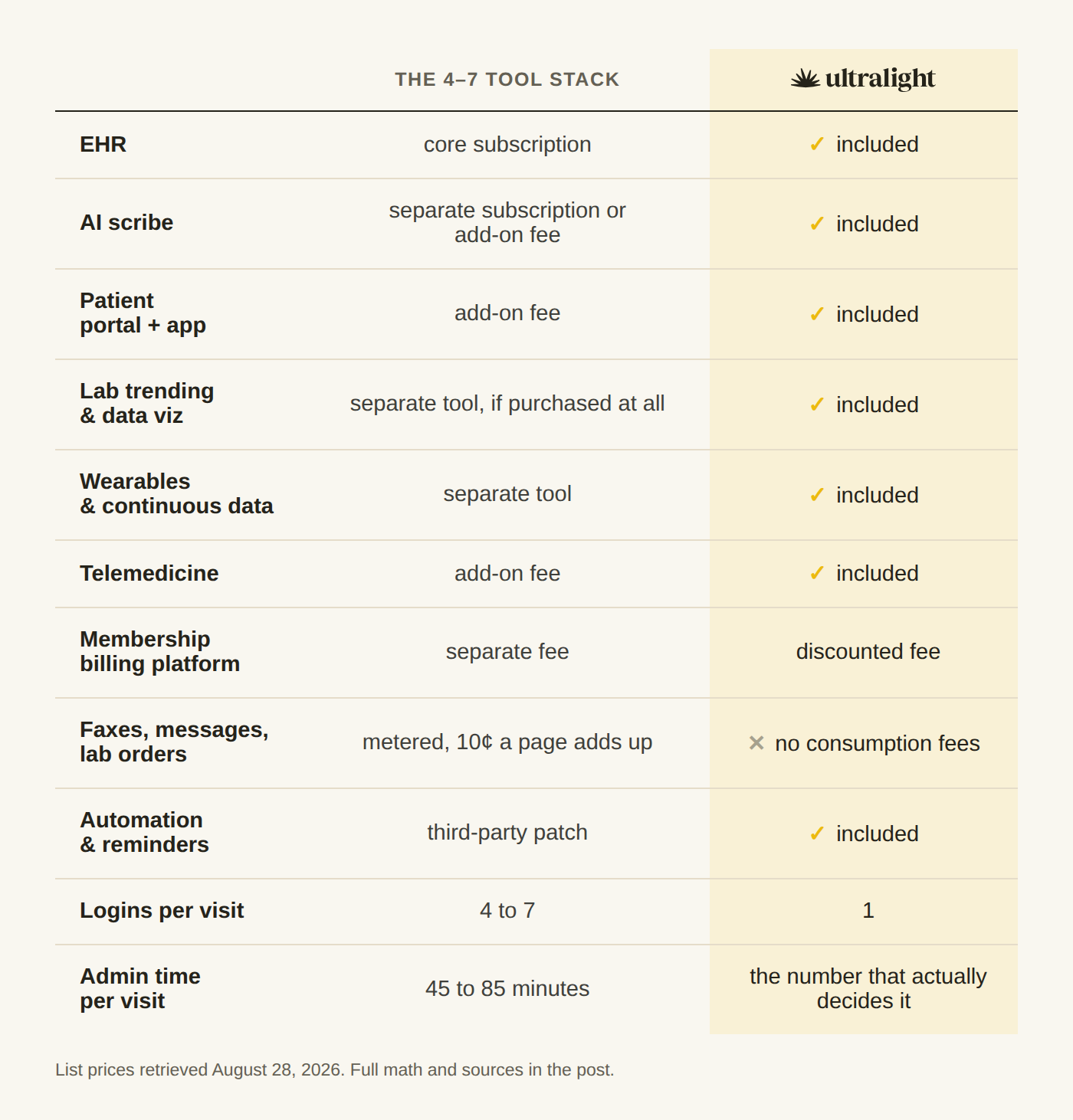
A single visit can cross four to seven logins before the work is complete, which also needs to account for the cognitive load of switching across platforms to complete the job.
Ultralight is designed to bring those core workflows into one platform: the EHR, AI documentation, clinical intelligence, laboratory and wearable trends, patient app, telemedicine, and follow-up.
And here is the part most vendor blog posts will not say: the straight-forward math does not always tell the full story.
I've spoken with a number of clinicians running small practices paying $99 for their EHR. They currently aren't using the other tools we lay out that could add value to delivering longitudinal care, and are doing much of their analysis by hand. But, perhaps they are running their practice part-time and don't have the volume to justify more spend in tooling.
I often tell these practices that if their main objection to moving to Ultralight is justifying a cost their practice can't handle, staying put may win.
If you are able to increase your revenue by offering more modern, personalized care to more clients and eliminate your manual lift, consider the volume increase you need to justify the investment and whether it feels realistic for you to get there. Today, Ultralight offers a Launch program with special to help you get your practice off the ground if you are under 50 patients to help with this transition.
But, if it cannot demonstrate that value in the practice's real workflow and the math does not work, the practice should not switch.
When the cheaper stack is genuinely fine
Some practices should keep what they have because the problem described in this article does not apply to them.
A modular stack may be entirely reasonable when:
- Your visits are primarily episodic, with little longitudinal data to review between them.
- You order few advanced diagnostics and receive limited patient-generated data.
- Your current systems make the relevant history easy to find without repeated downloading or re-entry.
- You are solo, relatively low volume, and the administrative work fits comfortably within your week.
- You are not capacity-constrained. Patients are not waiting to get in, and you are not working evenings or weekends to keep up.
- A best-in-class standalone tool provides a capability that an integrated platform cannot replace.
- The financial and operational cost of migration would exceed the likely benefit.
Episodic care on a legacy EHR can be a matched pair: the tool fits the job.
The mismatch begins when the medicine changes and the tools do not. The amount of data per patient grows. Advanced laboratory testing, wearables, imaging, genomics, and multi-system protocols need to be interpreted across time. The relationship extends between visits. The practice eventually runs out of hours.
That is when administrative time stops being an inconvenience and becomes the ceiling on the practice.
What we built for: the future of modern medicine
We built Ultralight for the job described at the beginning of this article: helping functional, integrative, and longevity clinicians see and manage the full longitudinal picture of a patient in one place.
The platform brings together the EHR, AI scribe, clinical intelligence, laboratory and wearable trends, patient app, telemedicine, care plans, and automated follow-up workflows. Core pricing is structured per seat rather than around separate charges for each of those functions.
The per-visit number is the one we care about. Crystal Brust, PA-C, who runs Farm to Functional, described her experience this way:
"Things that took me 10 hours per week are now done in a total of 30 minutes."
AI not only enables administrative work to move faster, but it allows our doctors to build more complete pictures of their patients faster and deliver personalized protocols with ease.
Crystal's case illustrates what an integrated platform has to prove: not that it has more features, but that it measurably reduces the work surrounding each visit while actually strengthening the clinical workflow.
Clinical summary and practice integration
Before renewing your current stack or moving to a new platform:
- Audit 90 days of technology spending. Include subscriptions, add-ons, per-user fees, usage charges, custom automation, and tools you may need to check your credit-card statement to remember.
- Time 10 representative visits. Include pre-charting, laboratory review, wearable review, documentation, medication and supplement reconciliation, care-plan creation, patient instructions, orders, and follow-up.
- Separate clinical work from tool friction. Interpretation and decision-making still require clinician time. Searching for data, re-entering it, reformatting it, and transferring it between systems are potentially recoverable.
- Set the threshold before the demonstration. Decide how many hours the platform must return, which tools it must replace, and how quickly the investment must pay back.
- Test one complete patient workflow. Use the laboratories, wearables, medication lists, supplements, care plans, and communication pathways your practice actually uses.
If the platform cannot return meaningful time without sacrificing clinical functionality or data integrity, do not switch.
If it can, the administrative-hours line may be the most valuable number in the entire comparison.
If you're curious to understand how you can modernize your workflows, book time with our team. We'd love to walk through your workflows and show you Ultralight in action.
Frequently asked questions
How much does an EHR cost for a functional medicine or longevity medicine practice? The EHR seat itself runs about $250 to $350 per prescribing provider per month at list prices, and it's usually the smallest line. The portal, e-fax, telemedicine, scribe, and data-trending add-ons around it take a working solo stack past $1,300 a month, itemized above, plus about $2,200 in one-time setup fees. For comparison, Ultralight lists $475 a month for a prescribing clinician and $50 for administrative access, with those capabilities included and no consumption fees.
How much does an AI scribe cost? Standalone scribes list between $39 and $119 per clinician per month depending on note volume and features; Freed's unlimited tier is $79. Some legacy EHRs now sell their own scribe add-ons for $29 to $59 a month. AI-native platforms that consider a scribe core to workflows, including Ultralight, charge nothing extra.
What is the most useful ROI metric? It varies. Start with recoverable administrative minutes per visit. Measure time spent searching for data, downloading reports, switching between systems, re-entering information, correcting documentation, reformatting care plans, and transferring instructions into the patient portal. Do not count clinical interpretation or decision-making as recoverable time. Then multiply the median number of recoverable minutes by weekly visit volume and value that time conservatively.
Doesn't switching cost more than staying? Sometimes the monthly sticker is higher, as in the example above. The comparison that matters is total stack cost plus admin hours against one platform. If a switch doesn't return meaningful time per visit, it isn't worth the migration.
What about the migration itself? I've been burned before. Fair, and it's the most common reason practices stay on tools they dislike. Ultralight handles data migration and onboarding directly. Using an AI-native platform is proving to be more inutitive that clunky platforms of the past, reducing the emotional challenges around migrations. Ask us for references from practices that came off your specific EHR.
Is per-seat pricing worse for multi-provider clinics? Per-seat pricing scales with your team either way; the multi-tool stack also charges per seat, it just does so across four to seven invoices (Cerbo per user, Spruce per user, scribe per clinician). One platform means one per-seat price that already includes what the others sell as add-ons.
Sources
- Cerbo pricing, retrieved August, 2026
- Freed pricing, retrieved August, 2026
- Spruce Health pricing, retrieved August, 2026
- Heads Up Health pricing, retrieved August, 2026
- Ultralight pricing, retrieved August, 2026
- Sinsky C, et al. Allocation of Physician Time in Ambulatory Practice: A Time and Motion Study in 4 Specialties. Annals of Internal Medicine, 2016.
- Arndt BG, et al. Tethered to the EHR: Primary Care Physician Workload Assessment Using EHR Event Log Data and Time-Motion Observations. Annals of Family Medicine, 2017.
- American Medical Association: Family doctors spend 86 minutes of "pajama time" with EHRs nightly, 2017 coverage of the Arndt study.
- Practice example: sales conversation, June 2026, shared with details anonymized
- Time figures: Ultralight onboarding conversations, 2025 to 2026
Vendor pricing changes; figures reflect published list prices on the retrieval date. Ultralight has no affiliation with the vendors named.