Reviewed by Dr. Lexi Gonzales, written by Ultralight CEO Sunita Mohanty, and edited by Provider Advocate Amy Maxwell
2026 is shaping up to be a turning point for functional, integrative, and longevity medicine. The reason isn't just a new biomarker or advancing research, but the infrastructure of care itself is finally starting to change.
The old model has hit its ceiling
The last true revolution in medical documentation happened more than fifty years ago, when we moved from paper charts to electronic health records. For the first time, clinicians could store and retrieve patient data from a computer instead of a filing cabinet. It was a breakthrough for its era. That revolution has hit its ceiling for the way modern clinicians practice functional and longevity medicine.
For years, clinicians have been telling us a similar story:
“My EHR doesn’t match how I practice.”
“I spend more time organizing information than thinking clinically.”
“Functional medicine doesn’t fit into episodic systems.”
Most EHRs were designed for billing, compliance, and acute encounters. They assume discrete problems, short time horizons, and documentation as the primary goal. Functional, integrative, and longevity medicine, by contrast, depends on longitudinal pattern recognition, synthesis across systems, and proactive strategy over months or years.
What's changing in 2026 is how we define what an EHR is supposed to do in the first place.
The market has quietly split into two types of EHR
When clinicians ask, “What’s the best EHR for functional or longevity medicine?” they’re often comparing tools within the same outdated model. They are looking at feature lists, templates, or integrations, without questioning the category itself. In reality, the market has quietly split into two fundamentally different types of systems:
Category 1: Functional-Friendly EHRs
These platforms were adapted to support functional and integrative workflows. They represent a meaningful improvement over conventional, billing-first EHRs and have enabled many practices to grow.
Functional-friendly systems tend to do a good job with customizable templates, protocol documentation, and patient communication. For many clinicians, these were the first tools that didn’t actively work against how they practiced.
The issue with these systems is that the clinician still does all the synthesis. Labs are reviewed manually. Trends are spotted through experience and repetition. Insight lives primarily in the clinician’s head. The current chart is a record of what happened and not an active participant in clinical reasoning.
Category 2: AI-Native Clinical Operating Systems
The second category represents a momentous shift. This isn't about plugging in an AI scribe or integrating an AI feature to an existing system. It's an architectural redesign from the ground up.
AI-native systems are built from the ground up around clinical synthesis. Instead of documenting visits as isolated events, they create longitudinal timelines and care journeys. Instead of storing labs as static PDFs, they transform data points into signals that change over time. And instead of bolting AI on as an add-on, they embed it as a cognitive support layer within the workflow itself.
Commonly Used EHRs in Functional, Integrative & Longevity Medicine (By Category)
Functional-Friendly EHRs
- Cerbo. A long-standing option in functional medicine with strong familiarity with traditional EHR design. Well suited for practices comfortable performing most interpretation and synthesis manually.
- Practice Better. Popular among health coaches and functional medicine practitioners, with customization features, AI integration, and group program delivery tools. Less focused on deep clinical integrations like e-prescribing.
- Power2Practice. A functional-friendly system that works well for smaller or earlier-stage practices, but can feel constrained as clinical complexity and scale increase.
- Healthie. Widely used in wellness and integrative settings, particularly for nutrition and coaching workflows, with lighter-weight clinical depth.
AI-Native Clinical Operating Systems
- Ultralight Health. An AI-native EHR built specifically for functional, integrative, and longevity medicine. Rather than focusing on static documentation alone, Ultralight Health (previously known as Vibrant Practice) is designed to synthesize labs, timelines, notes, and protocols into clinically meaningful insights and a living repository of medical assets practitioners can interact with, reducing prep time while preserving clinical depth and for many users… restoring joy back into clinical practice.
What differentiates Ultralight is not that it “uses AI,” but that AI is foundational to how the system works. Ultralight’s system uses longitudinal thinking, pattern recognition, interactive engagement with data, and care planning at the core of its workflows.
Comparing Functional-Friendly vs AI-Native EHRs
The table below reflects what clinicians actually experience day to day.
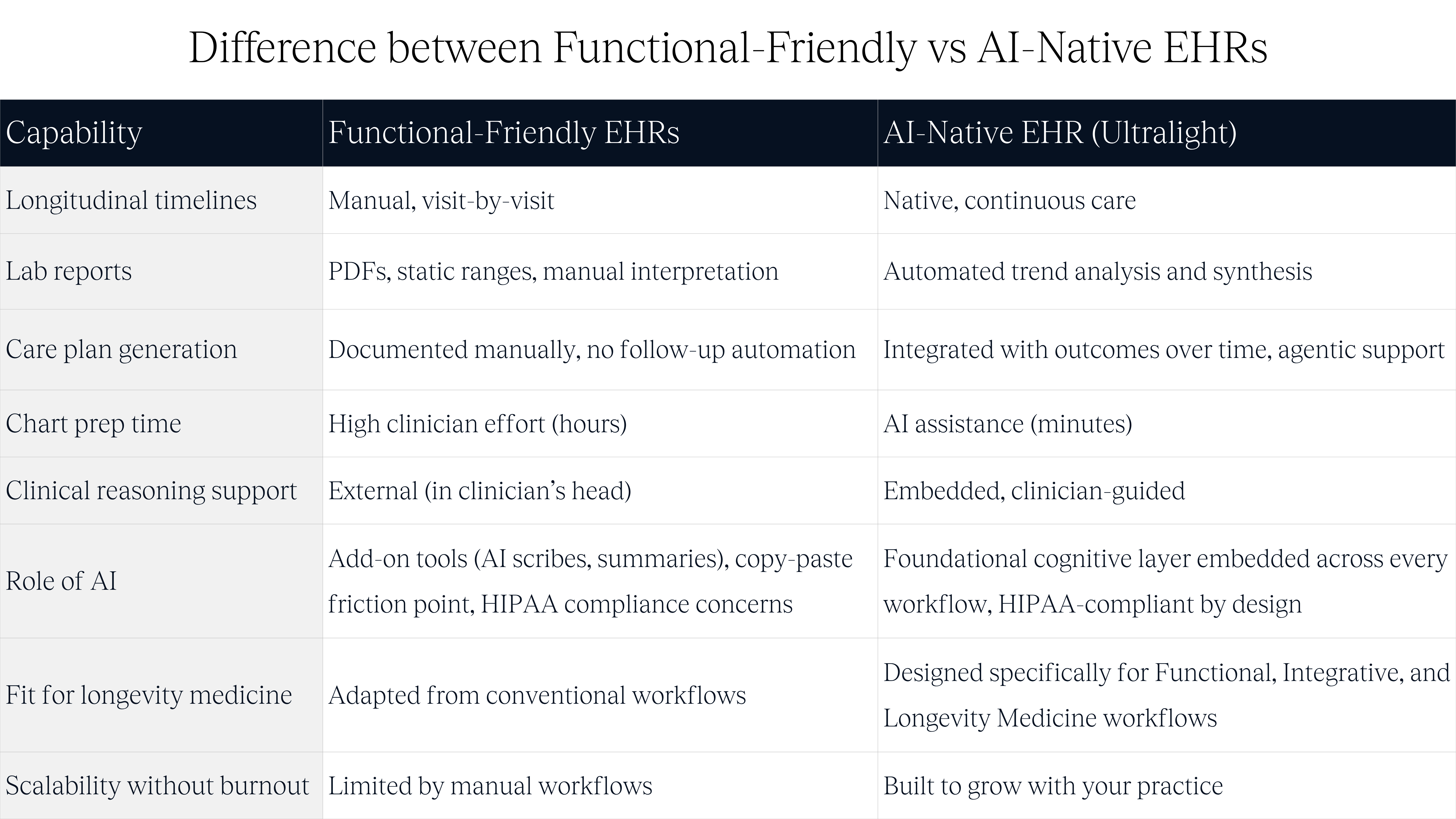
Is your EHR simply storing information? Or is it helping you think and improving your practice?
Why This Shift Is Happening Now
Functional, integrative, and longevity practices face pressures that conventional medicine largely doesn’t. Patients arrive with more data, higher expectations, and increasing demand for plans hyperpersonalized to their individual biology and lifestyle. Care is inherently longitudinal and no longer episodic. Retention depends less on “feeling better,” and more on “feeling value” through insights, clarity, and trust in the care they are receiving.
Clinicians are asking for systems that reduce cognitive friction. They don’t want more tools or more clicks. AI-native EHRs are emerging not because AI is trendy, but because the old model no longer scales.
The Takeaway
The best EHR for functional, integrative, and longevity medicine in 2026 isn’t defined by the longest feature list.
It’s defined by whether the system:
- Thinks longitudinally
- Synthesizes intelligently
- Respects clinical judgment
- Gives clinicians their time, clarity, and joy of practicing back
The shift from functional-friendly EHRs to AI-native clinical operating systems is already underway. The only remaining question is how your practice would evolve if your EHR system was your clinical copilot instead of the administrative tax we’ve been conditioned to accept.
Ready to see what an AI-native EHR looks like in practice? Book a demo with Ultralight.